When Doctor R. Morrow, an Irish physician at a Prisoner of War camp in Cape Town, applied for a posting to the Karoo town of Uniondale in 1901 he was assured that the Boer’s posed no danger, and were never likely to. But after only being there for eleven days, a Boer force of 250 men under Gideon Scheepers rode in and annexed the town for about 24 hours.
After freeing any white prisoners, Morrow tells us that Scheepers and his men then locked up the magistrate, the jailer and an outspoken English clergyman (he apparently refused to take an oath of allegiance to the Boers or even one of neutrality) in the newly cleared cells. Due to both Milner’s well-known proclamations on the harsh punishments for disloyalty to the crown, as well as his partisanship to the British cause, the good doctor found himself in a tight corner when asked to join one of Scheepers’s officers, Captain Hugo, for a drink in the hotel bar. When the customary toast was due before his first sip of his scotch and soda , the bar went deathly quiet and Morrow said: “Well! Captain Hugo, the only toast I can in the circumstances offer you is the wish that you may never trouble a doctor.”
Standing in the centre of the old British fort on top of a hill behind Uniondale, we imagined Morrow’s relief when the British 15-pounder opened up on the Boer force the next day. Not able to engage the better armed British column and having got the fresh horses and supplies he came for, Scheepers and his men exited the town in a hurry. There were apparently five forts built around Uniondale during the Boer War, a direct result — as it appears from Morrow’s writings — of Scheepers’s daring raid on the town. And, although another force of 300 Boers tried to take the town a few months later, they were repulsed by the British artillery and the indefatigable efforts of the town’s new garrison commander, who, apart from the regular troops at his disposal, had also organised an effective town guard.
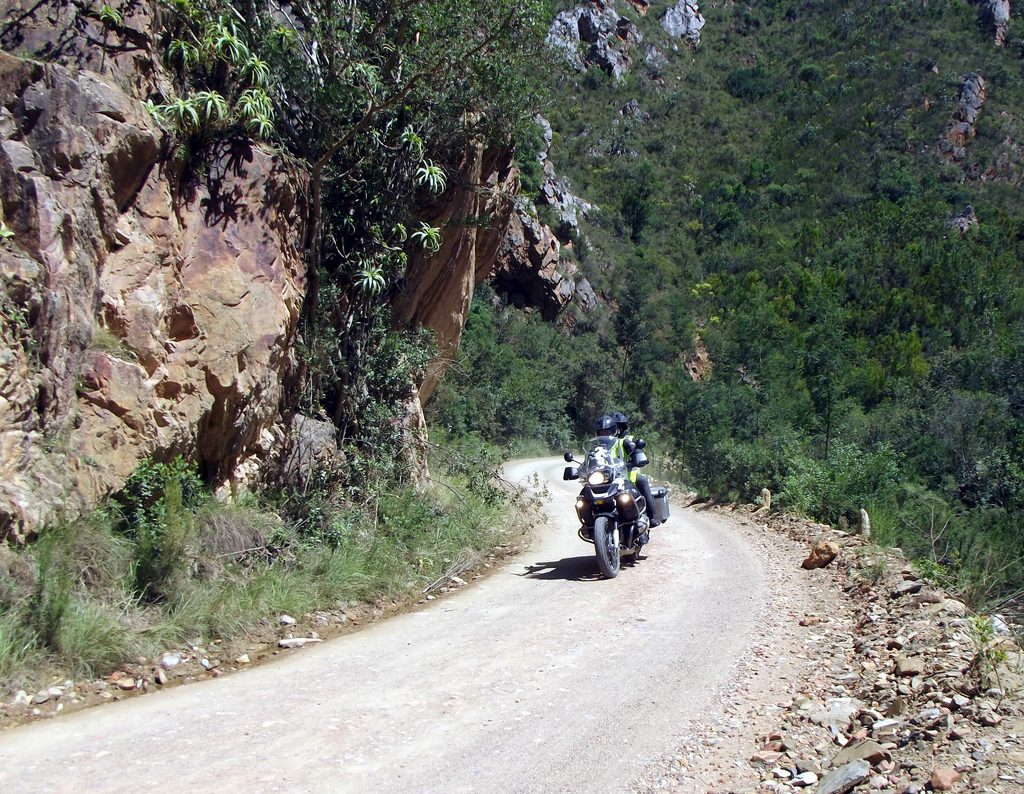
Although Morrow had arrived in Knysna by coasting steamer from Cape Town and I’d trailered my motor bike up from Bot River to meet our touring party, we pretty much followed the same road to Uniondale he did more than 110 years before – the Prince Alfred’s Pass. Okay, so his journey would’ve taken a day or two where ours only took a couple of hours, but it was still thrilling to think that we’d followed in the Doctor’s tracks.
Soon after its formation as a town in 1856, Uniondale became a reasonably important wagon building and furniture making centre. Local businessmen apparently sent out loads of furniture and fresh produce in newly made wagons into the interior on a regular basis. In exchange they would mainly receive cattle and slaughter stock which they would then sell on to buyers in the district at a good profit. Then, in the 1880s, like in so many of the region’s towns, the ostrich feather boom impacted on Uniondale and the relative prosperity that followed saw many attractive new buildings and homes being erected over this period.
But the Uniondale of today predominately serves as a base for retirees from farming and ex-city folk who’re looking for a quieter life in the country. A number of these city-escapees have transformed homes into attractive guest-houses, lodges and restaurants; and the one we visited for a late “stoep breakfast”, the Uniondale Lodge, has a flamboyant and eclectic charm all of its own.
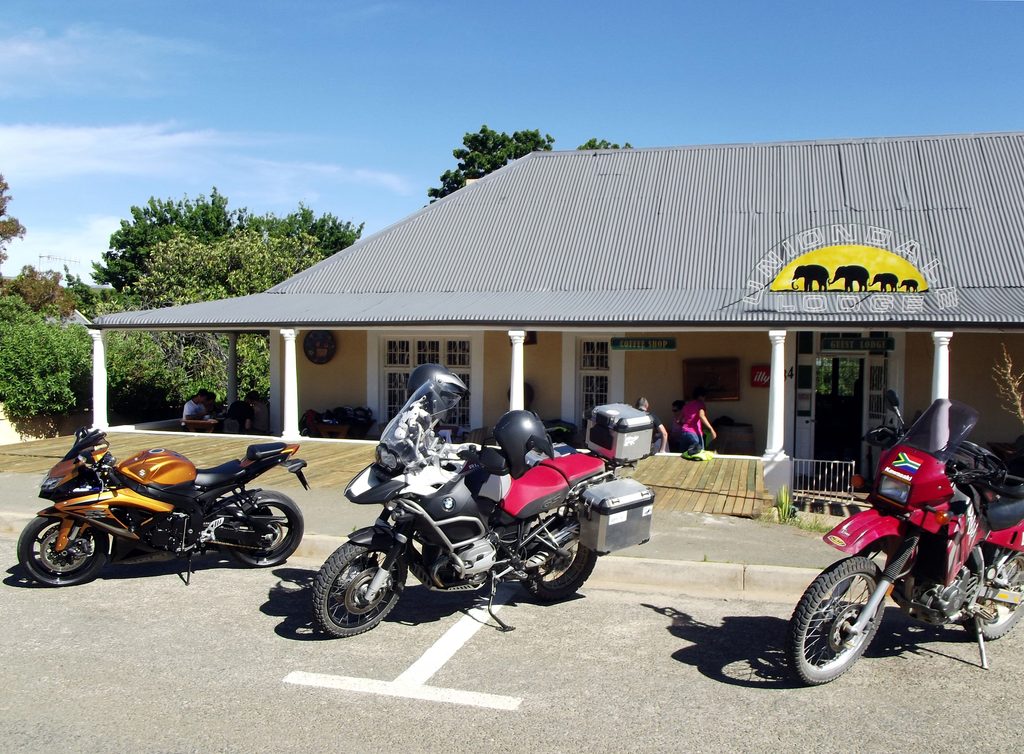
After visiting the old watermill — reportedly the largest in the southern hemisphere and which served the town for 100 years — we jump on our motor bikes and make our way to our farm stay at Hartebeest Post, around 18 kilometres east of the town. Although we’ve been made aware of the famous “hitchhiker ghost” of Maria Roux, an attractive young woman who was tragically killed nearby when her fiancé’s VW Beetle left the road in the Easter of 1968, we feel confident that we won’t be accosted by her; mainly because she seems to prefer riding in cars.
If you go…
Where it is: Hartebeest Post is about 18 km east of Uniondale and is accessed from the N9 to Willowmore. There’s 7.6 km of gravel to cover, but it’s easily done in a conventional car.
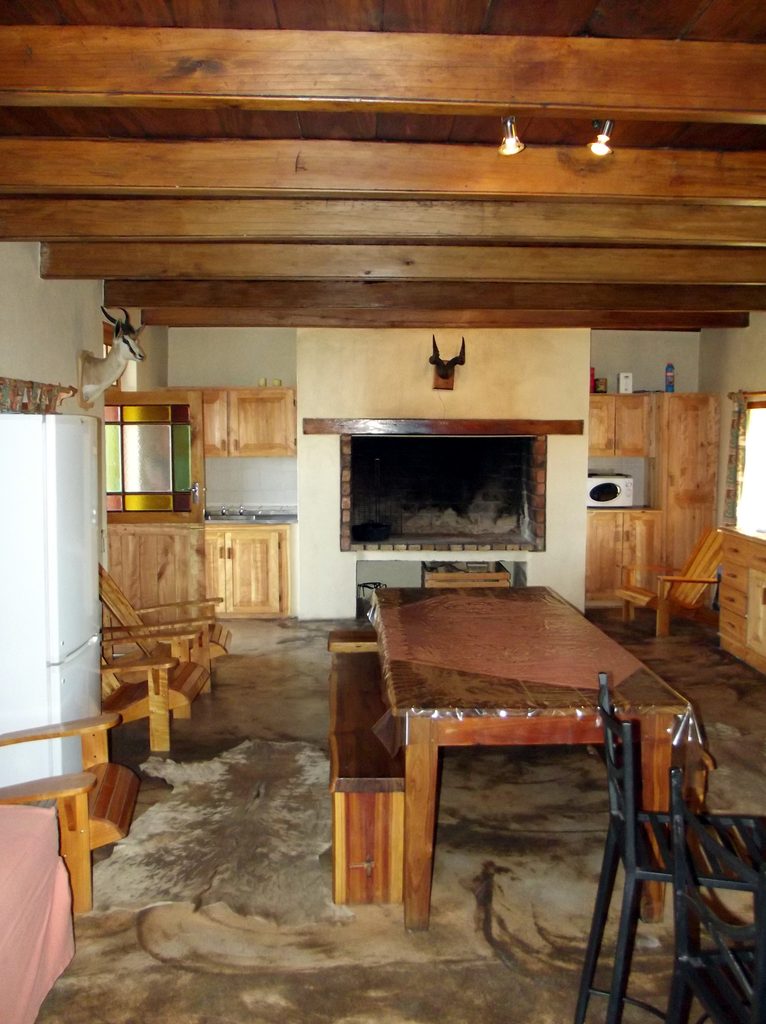
What it has: Hartebeest Post is a charmingly restored Victorian-style farmhouse with two stoeps, three separate bedroom units (it can sleep ten people in total — two have adjoining rooms) and all are en-suite. There’s a large communal area with cooking, dining and in-door braaing facilities and all the equipment necessary for self-catering.
Why go there: The farm lies on the good dirt track that is an alternative — and shorter — way into the alluring Baviaanskloof. But it’s also a destination in its own right as it offers a number of activities for the outdoor enthusiast. These include 4x4, quad, motor bike and Mountain bike routes on a network of dirt tracks that traverse the 11 000 hectare property. These tracks are also well-suited for rambling, hiking as well as bird- and animal- watching. But you may just want to chill and soak up the boundless Karoo space.
The food: This is a self-catering farm stay, but there are good restaurants in Uniondale.
Rates: Adults – R180 p.p.p.n and children under 12 — R90 p.p.p.n
Contact: MC or Lizette Loock on 044-752 1214 or 072 699 1163; email: loock@langkloof.net and website: www.wheretostay.co.za or www.uniondale.co.za