(Written for BIKE SA in 2008.)
If you are sick and tired of the crime, unreliable electricity, lack of good governance and thinking of leaving the beloved country, perhaps it’s time you bought yourself an adventure motorbike and toured SA. Nicholas Yell and his mates took a trip through the Eastern Cape recently and were reminded how the people and landscapes of SA are under their skins.
It was my discovery of the Hartenberg Cabernet-Shiraz that started all the trouble. The “Stone”, David and I were having a civilised dinner in the Victorian dining room of the Willow Historical guesthouse when it was suggested that I look for a good bottle of wine next door. And it was there I found the delicious red nectar that our palates could simply not refuse - and which caused us to stage an impromptu variety concert a little later on. Luckily the other guests had the good sense to retire early and probably the only really smart thing the three of us managed to do that evening was to resist going for a nightcap at the Royal Hotel.
“Scheez broe, do you think it’s alive,” asked the “Stone” pointing warily at a puff-adder on the side of the dirt-road just outside Willowmore. We decided that if the snake was still alive and was determined to feign death, it was likely to be killed by a car for real, so David chucked a pebble at it. The lazy “dead” snake slithered into life and sought refuge from our curiosity under a bush just off the road.
“I wouldn’t mind hiding under a bush myself today,” I said, and saw the others nod in deference to the king-sized hangovers that had colonised our brains.
But after a few hours of absorbing dirt-road riding and a few litres of water each, we began to feel almost human again. Yet it was our passage through the “Forgotten kloof” traversing the Grootrivierhoogte that really got our hearts pumping and finally flushed out the cobwebs of the night before. With an uneven rocky surface and thick sand in places, it’s the type of challenging surface that requires you to concentrate only on the moment at hand and makes you forget about anything else that maybe troubling you. And that’s why we call it Zen-dirt: the aim of riding it is to have little else on your mind, which ironically, can be strangely illuminating - but that’s another story.
“Look Nick, I know we misbehaved a bit last night, but I’m sure it’s not necessary to pray for forgiveness,” spurred David as he pulled up next to me outside the church. Being a bit faster on my more nimble KLR than the boys on their big Beemers, I had arrived in Mount Steward – a tiny rail-side hamlet – ahead of them and discovered the quaintest church on the edge of the village. The rest of the town’s dilapidated buildings seemed devoid of life, but it was clear from the recently tended garden that this building was different – it obviously thrived on the succour of the souls that visited it; even if that was only once a week or so.
A man I’d met on a previous trip through Jansenville helped us find the right road out of town. Strangely, finding your way out of town to the dirt-track you’re looking for is one of the most challenging navigation tasks on a back roads itinerary. And that’s because the scale of the maps you normally have to work with doesn’t show that you first need to head off on a number of other roads before you find the secondary dirt-track that you’re after. So it was really fortuitous that we’d run into Gustav at the petrol station, otherwise we might still have been circling Jansenville like a flock of disgruntled Hadedas with directional problems.
As Gustav had promised, our route followed an absorbing mountain road through undulating koppies and eventually led us through a steep-sided kloof that crossed a mostly dry river bed some 13 times. At a Y-junction a little while earlier, a farmer’s wife had stopped to tell us that she thought we were driving too fast and that we would “break our necks if we weren’t careful.” In fact she was convinced that the route we were following was altogether too dangerous and that we should turn around and try a more conventional one. Now I’m not knocking her concern, because she seemed genuinely worried about us, but we were going all of 70 km/h (our dirt-road average) and being as diligent and careful as our hangovers allowed.
By the time we’d crossed the broad Camdeboo plains between Pearston and Somerset East on the way to the heights of Bruintjieshoogte, it was time to don the rain suits. It had been drizzling on and off all morning and until that point, we’d coped pretty well with our normal riding jackets. But with the Beemers’ computer readings displaying 100C, it was time to seek extra cover. After the short bridge of tar before the Cradock-Swaershoek Pass turn-off, large grey banks of mist and drizzle started to swirl around us, determined to try and rain on our parade. Yet I was certainly more disappointed about the view being spoilt for the “Stone” and David – because this stretch of dirt-track is one of the most scenic in the country- than I was about the inclement weather.
It was just after passing a sign on a high electric game fence warning of the big five on the other side that my clutch cable snapped. The three of us stood there in the freezing rain and decided that a small swig of sherry from my “Medical Reserve” would be just the ticket to galvanise us into a mechanical frenzy. Suitably motivated, we tried to marry a bicycle cable - I’d bought it on a whim in Aberdeen just a week earlier - to the clutch handle and the release lever. And it may have worked if we’d thought to tie the clutch handle end on, instead of trying to slot the smaller bicycle toggle into the slot which was too big to grab it. Apart from this mental handicap, we were also concerned when the release lever lifted almost clean out the crankcase and thought that something may have sheared off inside.
Being a lot closer to Somerset East than Cradock, we debated the merits of each journey and decided to make for our pre-arranged destination. The challenge of riding a loaded trail bike, in the freezing rain over a narrow mountain pass with a hangover, becomes slightly more challenging when faced with mud as slippery as ice. It’s not that you need the clutch that much to change up or down, it’s just that you cannot afford to stop unless you’re on a downhill. So off I went, slip-sliding away, despite the vastly improved grip of my new Dunlop (D606) knobblies; making slow progress through the slush with the light starting to fade fast.
After finding a suitable downhill I stopped to wait for the Beemer boys. When they hadn’t showed after about 15 minutes, it was clear something had gone wrong. My challenge was now to get going in second gear and then turn around on the narrow muddy road without falling over in a messy heap. It took me about 5 kilometres to find a suitable turn-around spot and when I did eventually come across the lads, it took me another 5 kilometres before I was able to turn around again.
It turned out that the “Stone” had lost control of the big GS around a muddy corner and had ended up in a ditch, flailing about on his back like a moribund tortoise.
“You don’t understand broe, once this bike starts to go in this stuff, the momentum is just too great to stop,” said the “Stone” with serious expression. I was desperately trying to halt the wry grin that was spreading over my face as I pictured the comical scene. I blame my stepfather, Harvey, for my slapstick sense of humour – too many Marx brothers and Charlie Chaplin re-runs when I was a kid.
But luckily the “Stone”, strong bulky unit that he is, was unhurt and we slid on towards Cradock in the waning sunlight. The last 25 kilometres into town (about the length of the Swaershoek Pass itself) is extraordinarily beautiful. And when you crest the summit on a clear day as I’ve done before, you can see forever. Row after row of chocolate-purple peaks are stacked up behind one another, a symphony of mountains that results from the Winterberge in the east almost joining hands with the Stormberge in the west, and then marching northwards together. Sublime.
I was thinking about how to handle the traffic and town roads of Cradock when a large Kudu bull decided it was time to cross the road in front of me. One of our self-imposed rules is not to ride at night – and that includes twilight, because this is the time that the fauna gets restless. But with breakages and accidents having played their part in sabotaging our plans that day, we were denied the observance of this rule. Yet I was lucky, the kudu bull had obviously read the ‘love-life’ posters in nearby Cradock and scampered up a scree slope before I connected him.
I’d just thanked the universe for sparing me when an eagle owl tried to enter my visor. Breathing a sigh of relief that he’d missed me by a metre or so, I narrowly missed colliding with a bounding rabbit around the next corner. Moral of the story: leave on time (preferably without a hangover) make allowances for stoppages and get to your destination well before sundown!
By the time we reached Cradock nothing could scare me. I threw myself amongst the moderate traffic with the abandon of a man desperate for a hot bath and a cold beer. And the strategy worked. We arrived outside the Victoria Manor’s well- restored ‘Tuishuise’ cottages without further incident. We didn’t even have to go to reception. Vernon, the night manager, appeared like a welcoming genie as soon as I clattered to yet another jerky stop. Apart from bringing us room service menus and taking our drinks orders, the indefatigable Vernon also spoke to numerous potential mechanics that he hoped may come to the aid of my hapless clutch. Although Cokes and mineral water were in stronger demand than beer that evening, when our buffet dinners eventually arrived, we still managed to toast the day’s eventful passage with a glass or two of really well-travelled red wine.
The following day dawned bright and chirpy. We’d already decided the previous evening that if we couldn’t get my clutch fixed, we would have to abandon the Katberg Pass and head off on a newly planned route to Steytlerville. And just when we were convinced that none of Cradock’s mechanics could be enticed to miss the Sunday morning church service, Stanley the Samaritan arrived. He’d heard via Vernon’s grapevine that we’d had some clutch trouble and had come to see what he could do. Now, not only was Stan the man that can, he had a plan as well. He arrived with all sorts of clutch cable lengths and quickly determined that there was nothing wrong with the release lever or the clutch, he just needed to jury-rig the cable itself. It turned out that Stanley not only also owned a KLR, but he’d also had his clutch cable snap on a recent trip to the Baviaanskloof. So, as suitable Samaritans go, we certainly couldn’t have done better than Stanley. And to cap it all, he refused to take money and then also put us on the right road out of town.
The “Stone” was so in awe of the wonderful workings of the universe, and that our original trip was back on track, that he stopped to share his thoughts with an Nguni bull. We’d stopped on the side of the dirt-track to Tarkastad, which passes the impressive Lake Arthur and Kommandodrif dam, when David and I noticed the “Stone” wander off and engage the bull on matters of serendipitous fortune. The “Stone” is very fond of animals. Late one night on a previous trip, he’d told me that they understood him on an intuitively emotional level without him having to explain himself, like he often has to with humans. And when you’ve engaged the “Stone” late at night after his meagre red wine allowance has been consumed, it’s not altogether hard to fathom why animals are more easily able to understand his garbled grunting, than humans. But I digress.
The road works on the topographically varied dirt-route to Tarkastad added another dimension to the journey. The chevrons and narrowed stretches reminded me of those experimental drunk-driving courses you see on TV. But thankfully we were sober and it simply enhanced the ride – especially seeing that there was no traffic coming the other way. The weather had cleared up yet the crystal clear air still harboured an icy chill beneath its benign blue façade.
No matter how hard we tried, we could not find the dirt-road out of Tarkastad that was meant to lead us via the Bulhoek memorial site, on to Whittlesea. After the promised turn-off never materialised, we rode the blacktop until a local we’d stopped opined an interest in showing us the way. But when we were just short of Queenstown and he still hadn’t indicated our dirt-road turn-off, I started to have doubts about his navigational abilities. Yet sure enough, a few minutes later I had to swallow these convictions and we were reunited with our dusty travelling partner once more. But after a joyful five minutes we found ourselves at a T-junction with the main tar road from Queenstown to Whittlesea. Thwarted again.
The problem with asking directions from locals is that they assume that you want to travel the best road possible. No matter how hard you try to explain that you actually enjoy assaulting your kidneys and getting dust in your eyes, they can’t bring themselves to believe that - in the glorious age of bitumen - itinerant masochists still exist. So in the end, Whittlesea came up sooner, smoother and less enjoyably than expected. It’s a lively African market town and we stopped to take in the chaotic bustle of it all, and as usual, experienced more than we’d bargained for. A man with a bakkie-load of followers and a bass-load of beat stopped to gawk at our bikes. Before I could say: “Hey dear fellow, a motor bike is a very personal and precious article,” the stranger had mounted the KLR with a crazed look in his glazed eyes and was frantically looking for the start button. But the extent of my noblesse oblige was sharply arrested when he tried to put on my helmet.
Things could have got ugly, but we presented a united front against the stranger’s over exuberant onslaught, and while keeping a watchful eye on his followers in the bakkie, dissuaded him from riding off towards the horizon. It turned out that he was a nice enough chap after all, he just wanted to see what it felt like to ride a bike because he thought it would be much easier to “smokkel die dagga” using a motor bike than a car. After hearing that his dad’s drug running business had already garnered him a BMW X5 and a bevy of gorgeous women, we decided to proceed with our somewhat more mundane, and boringly legal, expedition.
From this point until we reached Carlisle Bridge past Fort Beaufort the next day, the scenery was impossibly beautiful; the mass rural poverty and erosion from overgrazing being the only blight on an otherwise magnificent landscape. As far as our navigation was going on the trip thus far, well since I’d installed my map holder on my tank, things appeared to be going just fine. Fine that was until the beginning of the old Katberg Pass was blocked by boulders - and a huge painted arrow convinced us to go right. And that’s where the trouble started.
Seemingly at a dead end in a rural African village some 10 kilometres later, I asked a shepherd for directions. Talking Xhosa to me like I was a native, he gesticulated to a muddy road leading up the hill through the village behind us. Amazed that we appeared to still be on the right track, I executed a neat right turn and fell over in a heap. Now it wouldn’t have been that bad if I’d accidentally slipped into a donga or clashed with some other sort of credible wheel-fouling obstacle, but I’d somehow tripped myself up on a small rock that fought a territorial battle with my front wheel. It was a bit like scoring an own goal; especially in front of a village audience who enthusiastically applauded and cheered my clown-like antics.
Trying to salvage any amount of dignity I had left, I jumped up and wrestled the KLR upright and waved goodbye. But my plans to quickly leave the incident behind me came to nought when we dead-ended in a mud patch at the top of the hill. And when we about turned, I managed to fall over again. Luckily, the small crowd that saw me fall the second time had missed my first dismounting, so they had no idea that I was fast becoming a favourite for “Goon of the year”. It was really odd; my balance, on right-hand turns in particular, had seemingly migrated to Mars and left me seriously handicapped before our assault on the most challenging part of the trip. I was determined to get my mojo back and after a few choice expletives aimed at the brain-donor inside my helmet, my small dim world brightened and I made a near faultless exit of the village and ably retraced our tracks to the boulder-blocked turn-off.
Nothing can prepare you for the rugged beauty and challenging track of the old Katberg Pass. At a fork in the road soon after we’d re-entered the blocked-off section, the “Stone’s” uncanny eye convinced us to go left and we proceeded along the rutted and overgrown track with caution. It was when the road almost disappeared completely and a deeply eroded dry river bed - punctuated by rising saplings- took its place that we knew we were in for one hell of a ride. Something about the challenge allowed my mojo to return and I powered through the dongas feeling a little sorry for the heavier Beemer boys behind me. Regrouping a good way up the hill, the “Stone” and I waited for David. He eventually appeared unscathed and told us that he’d been held up by some fence wire that had wrapped itself around his back wheel; the incident reminded me once again just how important it is to have wire-cutters in your tool bag.
We continued up the steep pass, through deep muddy puddles and over all manner of challenging yet enjoyable dirt-surfaces. At the top we were welcomed by a herd of handsome wild horses, and the sight of a mother and foal at full stretch along the soft green summit, is not something any of us will easily forget. Looking down into the U-shaped valley of Balfour with its collection of pug skin-like, folded green hills, we marked the giant hog’s back in the distance and after a short breather, bumped down the eroded track to the forestry station below. En-route we came across a wheel-sucking, 20-metre stretch of chocolate-brown gruel, but thankfully, the “Stone’s” nemesis failed to unseat him that time.
“Never underestimate advice given by locals” was the proverb I promised to coin once we made it across that back-breaking piece of hell on the “mountain road” from Seymour to Hogsback. The receptionist at “The Edge” had told me the road was: “a pretty bad 4X4 track”, but when I’d replied that we liked “pretty bad”, she’d acquiesced and said we’d probably make it okay. But nothing could have prepared us for that 30-metre section of non-road: half-metre deep ruts alternated with boulders to produce a track that a Unimog would have struggled over. Stupidly, with my confidence now back to normal levels, I thought I would take a run at it without waiting for the Beemer boys to catch up. Big mistake.
To my credit though, I made it about two-thirds of the way and then had an altercation with a boulder that I just couldn’t win - and came down pretty hard. When the back-up team arrived I already had the bike upright, and when the “Stone” and I managed to manhandle the KLR onto the right line, off I went. Then came the task of helping the big Beemers through. Even being guided by two helpers, both riders fell off a few times, and it was with the sun starting to set after half an hour of tortuous, back-breaking effort, that we broke the hog’s back and rode eagerly towards some refreshment and respite at “The Edge”.
It had been another hugely eventful day and when the lady who met us at reception indicated the restaurant was actually closed and asked: “didn’t you get our message”, I nearly had a sense of humour failure. But thankfully, the bar was still open and after lavishing some charm on the chef and convincing her that we’d be happy with whatever she served up, she eventually came to the party and we made our way to our cosy cottage down the hill. After three falls in one day, I was feeling slightly stiff and decided to walk back to the restaurant for dinner. The cool night air had an invigorating wet pine smell, and I was just savouring it when the Beemer boys blipped past me in a fug of unleaded carbon monoxide. “Phillistines”, I yelled after them and heard the “Stone” cackle loudly into his helmet.
Dinner was a homemade chicken pie and vegetable affair and we partnered it with a delightful De Meye Little River red blend. But after the big day, and much to the chef’s delight, we headed home early and had a night-cap next to a roaring log fire. It wasn’t long before the resonant sound of three inharmonious woodcutters threatened to wake up the giant hog on whose back we were sleeping.
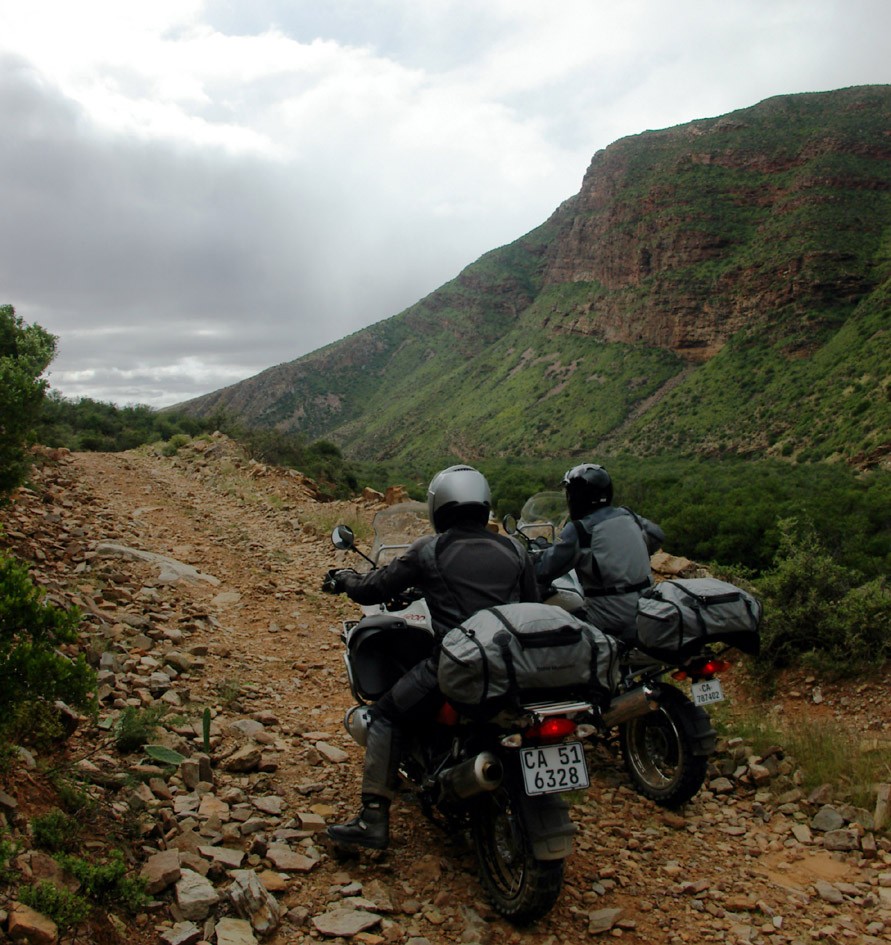
The promise of an evening cabaret at our overnight stop at the Karroo Theatrical Hotel in Steytlerville saw us on the road just before nine o’clock. There was no avoiding the 70 or so kilometres of tar to Fort Beaufort, but for the first time in a long while, I was actually grateful to ride the dreaded oil slick. Our bodies were sore and tired and the easy cruising on the tar gave us a chance to come awake gently and warm-up for the challenges that could still be lying ahead.
Besides David nearly being sideswiped by a motorist he was overtaking (the driver was trying to avoid one of the numerous potholes) our journey to our next dirt-road turn-off was fairly uneventful. It was exactly where it should have been, a little way out of Fort Beaufort on the R67 to Fort Brown, and was well worth the wait. The road was flanked on either side by thickets of acacia trees and lush grasslands, and about 20 kilometres in, I was confronted by a squealing family of bush pigs and started to feel at home again. Soon after that I had a close encounter with a long green snake with a yellow belly stripe. It was one of those situations where a collision was unavoidable, so I accelerated and raised my legs into the splits position and just missed crushing it - or being bitten in the process.
It was directly after refuting a farmer’s assertion that we looked lost, that we missed the turn-off. The thing with these back road safaris is that turns that are meant to be there often aren’t, and those that are not, are. But after years of practice, the compass in your gut starts to tell you things like: “Hey dude, why head east when you should be going west”. And failing that, find a local on horseback and ask him where the hell you are; although chances are, as happened to us, he only speaks Xhosa. But luckily, town names are the same in any language and after some serious semaphore; we knew we had to retrace our steps.
We rode along the backs of lofty rolling hills with game-fenced farms on either side, garnering great sightings of many different kinds of antelope along the way. It’s a long story, but for most of the trip I’d been looking for a fast-flowing river in which to throw a red envelope. And thankfully, the Koonap, a tributary of the Great Fish River we crossed enroute to Carlisle Bridge, proved to be just the river I was looking for. We spent the rest of the day travelling across a landscape which was slowly morphing from verdant grassland back to Karoo stubble. All the way, we rode through or were surrounded by, game parks or game farms. It was a real wildlife fest, we spotted: kudu, eland, red hartebeest, wildebeest, ostrich, vervet monkeys, warthogs and, I kid you not, a herd of sparkling white springbok.
By the time we pulled into the Karoo Theatrical hotel in Steytlerville, (an ideal bikers’ venue) we’d covered over 410 kilometres, three-quarters of which had been on dirt. Those cold beers on the hotel’s stoep, with the Karoo sunset starting its molten-orange and silver light show in the west, won’t easily be forgotten. But the real ‘end of trip’ celebrations were still to come. The owners of this unique establishment, Mark and Jacques, are seasoned cabaret professionals and they’d promised us a performance of their new show after dinner. And judging by the rapt expressions on David and the “Stone’s” faces, they thoroughly enjoyed the excellent performances of this talented duo.
After a hopeless game of snooker on the full-sized table in the bar – David is colour blind and the “Stone” and I were both slightly handicapped by goonitis - we decided to throw in the towel and go to bed. It had been the most amazing trip and perhaps the only thing we might do differently next time is celebrate at the end – instead of the beginning.
Then again, maybe not.