I’d ridden past the sign to Die Mond many times. But I’d always been careering off to a destination far beyond this much vaunted stopover at the foot of the Hottentotsberg in the Tanqua Karoo. Itching for a short weekend ride, I decided to check it out and try out some new dirt tracks I’d being eyeing for some time as well.
I was deep in thought, burbling along at about 90 km/h on my faithful mount, Yeeha! when a big tawny cat with tufted ears bounded across the road just 50-metres in front of me. It moved with the liquid grace and elasticity that defied its skeletal structure, easily vaulting the six-foot game fence in front of it. Understandably maligned by sheep farmers, sightings of the Lynx, or Rooikat as these feline fugitives are known, are very rare.
I stopped on the side of Montagu-Touws River dirt track and tried to pick it up again as it slunk away through the Karoo bossies. But I didn’t see it again and I began to wonder whether the fistful of cold medication and vitamins I took before leaving home were making me hallucinate. Either way, it should make for an interesting trip; I thought and cackled loudly to myself before setting off again.
Although, I’d worked out my distances fairly carefully over breakfast in Montagu earlier, I was still a little apprehensive about setting off on a solo return trip through the desolate Ceres and Tankwa Karoos with only a 10 % margin for error. This is not only because I have a penchant for getting lost even while not on medication, but my divider measurement system I use to mark off distances on my old Engen maps is not always that accurate.
My first new dirt track, marked Droekloof it turned out, came up sooner than I had estimated. I had expected it to be about 12 km from the Hottentotskloof junction with the R46 in from Touws River, but it appeared after only 9 km, about a quarter way up the enjoyable twisties of the Theronsberg Pass.
Seeing this new serpentine-like track snaking its way into craggy hills in the distance, I was as excited as a kid about to open a mystery present on Christmas morning. You see, discovering a new dirt track for me is akin to a stamp collector coming across a Penny Black or a Cape of Good Hope Triangle. And if the track turns out to be little used and leads me through remote countryside with jaw-dropping scenery, well so much the better.
The Droekloof road was all of this and more. When I did my route planning, I had eschewed the shorter version of this route which connects to the R303 to Op-die-berg from Ceres after only 29 km; preferring to head north towards Lochlynne Dam and then east to the R303 a bit later; a total distance I’d estimated of some 44 km of new dirt track.
After about 10 km post this kilometre reading, though, I realised I must have missed a turn somewhere. But the dirt track I was riding was so beguiling I couldn’t bring myself to turn around — the spectacular scenery just kept pulling me in. I was completely intoxicated by the unusual rocky battlements that had risen up all around me, some manned by soldiers of stone who were frozen in space and time; and all the while these magnificent sculptures were accompanied by the most serene lake on my right.
Mesmerised by the unfolding tableau I stopped the bike next to a ridge, clambered up to a good vantage point and drank it all in. Hemmed in by the narrow kloof at first, the lake expanded as the valley widened further on. It’s gently rippled surface was the colour of beaten pewter under blue glass. The body of water slid by sibilantly; large birds flew over on lazy wings and cormorants squawked contentedly. All was well in my world.
Adding to the timelessness of the setting was the cave below me. Its blackened roof and the presence of bones suggested that it was once a Bushman (San) shelter and possibly the lair of a leopard or Rooikat at some time as well. And if that wasn’t enough, I then discovered what looked like a fossil skeleton in a low-ceilinged corner of the cave, quite plausible in this riverine environment; but then again my imagination was flying high on drug-fuelled wings, so I wasn’t one hundred percent sure.
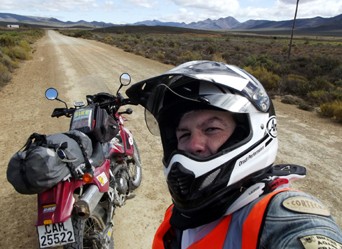
Dazed, confused and off-piste, Nick had no idea where he was headed.
All was going swimmingly on this delightful detour until the road terminated in a cluster of farm buildings. Lesser dirt tracks like these do lead you through farmyards, but this one seemed simply to end with a very official looking sign saying “No visitors beyond this point without permission.” But even if I’d wanted to turn around I realised I could be faced with a petrol shortage later on, so I pressed on into the farmworkers housing scheme and made like I was Manuel of Fawlty Towers’ fame — from Bathelona: “I knowa nothing, I’ma lost.”
The foreman saw through my rouse almost immediately, giving me the lazy eye as I laid on the charm and self-deprecating humour a bit too thickly. But he did end up revealing the news I wanted to hear: “Just go straight with that road,” he said pointing to a jeep track that reminded me of the challenging Eselbank to Wuppertal back route.
Although it was encouraging news that I would still be able to make it through to Op-die-Berg on this road, I had no idea how far off target I was; that much I hadn’t been able to ascertain from the concert of farmworker’s voices that had eventually set me on my way. And the more I travelled down this jeep track the more it became like the Wuppertal back route: sandy, very remote and with a gravitational pull that tries constantly to unseat you.
To make matters worse, my feel-good cold medication was starting to wear off and my supplies were buried too deep in my baggage to think of retrieving them. My ailing body and mind was performing like a circus monkey on Valium — at least a few seconds behind the action. As a result I chided myself mercilessly, lest I fall over in a lonesome heap and become fodder for the legions of Cape Vultures I knew were conspiring about which body part they were going to eat first when I finally succumbed.
After about 15 km I reached a large packing store. Thankfully, some kind farmworkers directed me to an exit gate; but there was a problem. It was a large electronic security gate and I would need to stalk another car exiting the gate or re-enter my “Manuel” persona. It was either that or face the fruit farm’s stern-looking security guards and try and explain to them why I was trespassing.
I decided to just take a chance, rode up to the gate full of confidence and saluted the on-duty security man with a sense of belonging there. The gate opened miraculously and I was through. I felt a little like I’d escaped from Guantanamo Bay and raced for the junction with the tar road. But, when I got there, I was confused. The signboard said: Kagga Kamma right and Op-die-berg left. Eventually the penny dropped, my circuitous detour had cut a 50 km corner for me and I didn’t have to travel on the R303 at all. All was well in my world again.
I followed a group of old W123 Mercs on an outing up the Katbakkies Pass and hot-footed it across the high-lying plateau that makes up the Swartruggens Conservancy. Having made up some time, I decided to celebrate my successful detour with a spot of lunch at the top of the Skittery Pass (also known as the Peerboomskloof Pass) overlooking the Ceres and Tanqua Karoos. Originally a Khoi sheep herding trail, early European farmers used it later as a wagon track to move between the Koue Bokkeveld and the Ceres Karoo.
After the lunch of adventure biking champions (pilchards and tomato sauce on Salticrax) I made my way down the Pass and on to the junction with the R355. Turning towards Calvinia, I put my head down and gapped it down the wide dirt track at about 110 km/h, feeling that with an extra 50 km fuel at my disposal I could afford to burn it a bit.
The road into Die Mond has had much written about it. Many people lament that its sharp stone surface and serious corrugations have shredded their tyres. And when you’ve made it across the exacting R355 with your tyres intact and then get a puncture just kilometres away from your promised oasis, it’s easy to lose your sense of humour.
It was with these foreboding thoughts that I tackled the 21 km dirt track in front of me. Even though my earlier detour had saved me a bit of time, heading west at 4.30 pm in winter meant that the sun was directly in my eyes. And with this handicap and the angle of the sun transforming the corrugations into even more severe-looking obstacles, I stood up and concentrated as hard as I could. I was determined to get to Die Mond without mishap and could already taste that first scotch as I watched the sun going down over the water.
In the end the road was not nearly as tricky as I’d heard it made out to be. Sure, there are some deep ruts, sharp stones to be avoided, sandy patches and a host of bothersome corrugated sections, but nothing that will upset a focused adventure rider. More enervating at the end of a long day in the saddle were the four gates I had to open and close en route.
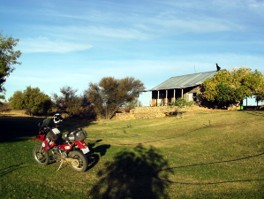
Basic chalets, lovely campsites and rolling green lawns
welcome you to Die Mond.
But, at the end of this road lies a veritable oasis. Situated at the confluence of the Groot and Matjies Rivers on the border of the Ceres and Tanqua Karoos, Die Mond presents the most incongruous spectacle of riverine lushness in an otherwise desolate moonscape. There are around 12 campsites which share ablution facilities with 5 basic cement-block chalets. Not wanting to trudge to the toilet in the middle of the might, though, I chose the smaller of two additional stone cottages with bathrooms and while it was very rustically decorated and furnished, it was clean and had everything I needed to self-cater.
“What are you guys hoping to catch,” I asked my neighbours who were on their way back from casting their lines into the nearby river.
“Yellowfish,” the man answered with a smile, “yesterday my wife caught a really big one,” he continued, his arms stretching apart about half-a-metre in the elastic demonstration of fish measurement used by all fishermen.
His name was John. He hailed from Wellington and has apparently been coming to Die Mond for years. His only regret was that he hadn’t left a small boat here he told me, because the river is apparently navigable with a small boat for about 2km east of the resort. “And up there,” he enthused with a glint in his eye, “you’ll find wonderful bass fishing spots; and bushman paintings, too.”
Having made a mental note to dust off my fly-fishing gear and come back here to cast for some yellows one day, I sat down to a classic camp chow of breyani mixed with vegetable curry. Accompanied by a scotch or two, I enjoyed a merry night under the star-studded sky, content to look for the sparkler trails of shooting stars and the roving satellites that blipped their way across the firmament. I was happy as Larry.
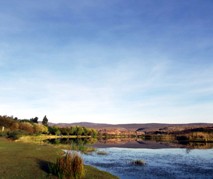
An oasis in the Tankwa desert — Die Mond.
I was up early the next morning. I’d only realised when I went to turn on the hot water the night before that there was no geyser — a donkey system for which a fire had to be lit in the braai oven was located out back. In the orange glow of dawn I took a walk along the river and collected kindling wood for my fire and startled a dorper ewe which had just given birth to two glistening lambs in the long soft grass on the river bank.
By the time I’d packed up and had my breakfast, the water from the donkey was piping hot and I enjoyed a long warm shower. My route plan for the day was to head back down the R355 and then the R46 to Touws River, where I would need to fill up, and then follow the Leeubosfontein dirt track and the spectacularly scenic Koo Valley road into Montagu. From there I was still undecided how I was to get back to Bot River, but would probably access the N2 from Stormsvlei.
After attacking the Die Mond exit road with more verve and vigour with a good night’s sleep behind me, I headed south on the R355. On the way in yesterday I’d come over a rise and narrowly avoided colliding with a donkey, so I was wary when I neared the same place second time around. Lots of donkey droppings showed that he was nearby, but I couldn’t pick him up anywhere on my radar. But then he appeared from behind an acacia tree on the rocky veld, still wearing the same small piece of tartan blanket around his neck he’d had on yesterday and I wondered what had become of his master.
“So which way are you headed home, boet?” asked the adventure biker who introduced himself as “Ralph from Wolseley”. I was holed up on the stoep of the Tankwa Padstal, drinking an ice-cold Coke when Ralph and his band of brothers from all over the Cape rolled in for brunch and a few hydraulic sandwiches. The reason he was asking me this question was that he was concerned I was on my own and thought it would be a good idea if he and one or two mates followed my route for safety sake. What a mensch.
As part of my own fail-safe plan, I’d promised my life-partner, Annette, I would call her by 12 noon. And with cell reception only available just outside Touws River I unfortunately couldn’t spend much time getting to know this great bunch of guys before having to leave. What I did learn from Tankwa Padstal owner, Hein, during my short visit, though, was that they are now stocking some second-hand adventure bike tyres (courtesy of Wild Dogs’ members apparently) which riders in need can have free of charge. All they need now are other good Samaritans to donate some second-hand tubes of various sizes — anybody?
With the Total Petroport and the Steers in Touws River closed for some reason, my plan for a leisurely Steers brunch was in tatters. I back-tracked to the BP down the road and discovered that they fortunately had a functional restaurant. Before my heart-stopping “Karoo breakfast” arrived, a table of adventure-bikers introduced themselves by their nicknames, and we chatted a bit about where we’d been and the experiences we’d had.
But as interesting as the banter was, I struggled to concentrate. I just couldn’t get the picture of one of their number out of my mind. His right arm was missing and he seemed perfectly happy to go by the nickname “Right-less”. When they were about to leave and he got onto his Yamaha XT660 Tenere I noticed that he had put on some sort of prosthetic arm with a gloved hand and seemed fully in control of his mount. Hats off to you Mr “Right-less.”
The route and travel notes:
Day 1: Bot River to Die Mond — via Scherpenhewel and Robertson to Montagu (145 km – 75 on dirt); to Touws River via Ouberg Pass (110 km – all dirt); Touws River to Droehoek turn-off from R46 to Ceres (52 km – all tar); from here via Lochlynne, Winkelhaak and Harmonie Farm to Kagga Kamma dirt track (55 km – 52 on dirt); to the R355 via Katbakkies and Skittery Passes (39 km – 32 on dirt); from here to Die Mond turn-off from R355 (41 km – dirt) and Die Mond entrance road (21 km - dirt)
Distance Day 1: 408 km, of which 331 km (81%) on dirt tracks
Day 2: Die Mond to Bot River — via the R355, R46 and N1 to Touws River (142 km – 99 on dirt); via Touws river- Montagu back track; Leeubosfontein dirt track and Koo Valley road to Montagu (102 km - 55 km on dirt); from here to the Maandagsoutrivier pad outside Riviersonderend (73 km – tar); and onto the R326 (7 km –dirt) ; via Jongensklip to the N2 outside Caledon ( 38 km – 31 on dirt) and then on the N2 to Bot River ( 41 km – tar) Distance Day 2: 403 km, of which 192 km (42%) on dirt
Total distance travelled: Around 811 km over 2 days — about 64% on dirt roads.
Experience required: Intermediate
Best time of year to go: April to September
Route highlights: The Droehoek dirt track to Houdenbeck; the Die Mond entry/exit track and the Leeubosfontein dirt track.
What it cost me: Accommodation – R200; Petrol, snacks, food and drinks: R600. Total cost: R 800
Accommodation notes: Die Mond chalets and camping. Contact Lindi on 023-317 0668