(Klein-Karoo and southern Eastern Cape – written in 2015 for Offroad & Adventure)
The 1.5-metre Cape Cobra made its way across the dirt track in front of me and there was seemingly no way I could miss out on my projected collision course with the serpent. Sounds kind of biblical, I know, but I really had to accelerate hard to try and avoid riding over it; and more importantly, not to give it a chance of injecting its deadly venom into my right leg.
Thankfully, I came abreast of it pretty fast and the magnificent copper coloured villain only managed to strike at the dust trail in my wake. It was not the kind of start I’d been hoping to make on my first dirt track ride on my newly purchased Honda XRV750 Africa Twin. In fact, riding alone on a new mount with a recovering sprained pelvis, I’d seriously considered not doing any dirt en route to meet my PE riding compadre, Johan Hamman, in Uniondale. But I was anxious to experience the handling of my newly-shod (Capra X knobblies) legend and decided to make the 75 km Dysseldorp-Uniondale dirt track my first testing ground.
And besides my harrowing experience with the Cape Cobra, I was very glad I did. Taking my close encounter as some sort of warning sign from the universe, I started off a bit tentatively — getting the feel of the heavier bike on the dirt; how its brakes worked on gravel and testing the grip of the new rubber before pushing the limits a bit.
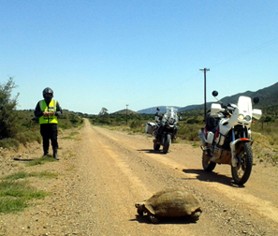
Steytlerville.
But there’s a reason these old Africa Twins had the go anywhere reputation they enjoyed until Honda took the questionable decision to stop producing them in 2003. Even though the bike is a good deal heavier than my KLR (218 kg* vs 198 kg wet) the low-gravitational balance of this bike is nothing short of phenomenal. And this combined with the excellent traction provided by the Capra X rubber meant I was rocketing through the corners in no-time and ended up doing the taxing 75 km route in less than an hour.
*(when I had to weigh the bike prior to the roadworthy certificate being granted, it came in at a surprising 200 kg, and that was with about 20 litres in the tank – but my bike does have some of the original heavy bits missing i.e.: original front fairing and big headlights have been replaced, old analogue speedo and tachometer have been exchanged for a lightweight digital version and there are also no tubes in the tyres anymore. But this doesn’t really account for a difference of 13kg – perhaps the weighbridge in Grabouw is a bit inaccurate?)
I arrived at my meeting with Johan in Uniondale a few minutes late, but with a broad smile on my face. After filling up the Twin’s tank (quite a thirsty beast this: around 13 km to the litre and about 50% more expensive to fuel-up than my KLR) I stocked up on a few cold ones and we headed off for our planned braai at one of my perennial accommodation favourites: Hartebeest Post farmhouse on the dirt track to Baviaanskloof.
Our turnaround destination for our three-night, four-day trip was the quaint village of Bathurst in the heart of the old settler country of the Eastern Cape. This historic destination was chosen primarily for the variety of new dirt tracks it afforded me; but, being able to watch the Bok vs Kiwi rugby semi-final and stay over at the one-of-a-kind Pig and Whistle Inn, was certainly an additional motivating factor. The route plan for the next day was to ride the dirt tracks to Steytlerville (taking the scenic route that runs north and parallel to the road through the Baviaanskloof); then onto Kleinpoort on more dirt; to Alicedale via Kirkwood on a mixture of gravel and tar roads and then from there to only follow dirt tracks and pass just to the north of Salem, finally routing through Southwell to Bathurst — a total distance of about 450 km.
“How about a small swig of bee-sting to ward off the chill?” I asked Johan before we turned off the R332 to Willowmore onto the secondary dirt track leading to Steytlerville.
“Ja, that’s a great idea. I wonder what happened to the weather forecaster’s other half of the predicted 33 ° C?” he replied.
The swig of OBs and honey liquor blend — kept in my tank bag purely for medicinal purposes you’ll appreciate — worked a treat at putting some warmth in our bellies and we headed off into the wilds, well-fortified against the unexpected cold weather.
I last rode this section of road around eight years ago when the “Stone” (due to make a comeback on the adventure riding trail early next year!) David and me rode our first Baviaans Tour together. Although we’d come from the other side at dusk, I still remembered certain twists in the road and one particular stretch where we’d had to avoid entangling ourselves with streams of errant fauna that had been determined to unseat us that day.
But the road was rougher than I remembered it; probably due to the zero maintenance dirt roads in the Eastern Cape appear to receive from government these days — the nearby Baviaanskloof road being another case in point. Yet, the condition of the road certainly didn’t bother two adventure bikers out for a challenging trail ride. On the contrary, the varied track, with a number of sandy and deeply rutted sections, kept us in the moment and where we had time to take our eyes off the road for a moment or two, the arresting vistas of the rugged Baviaanskloofberge, coated with dappled sunlight, were a real treat to take in.
The Twin was handling beyond my wildest expectations. Some years back, I’d ridden a friend’s Twin on a tour to Bonnievale Farm with the “Bearded One” (also due to make a comeback on the adventure riding trail next year!) and we had also experienced some testing dirt track along the way — an old ox-wagon trail we termed: ‘The road of bones’ at the time. And, while I’d been pretty impressed with its handling then, being someone else’s bike, I’d been more tentative with how I rode and not pushed any sort of limits. Perhaps the confidence I was starting to feel on my own Twin was a combination of luggage placement (ATG bag in-line behind me), the much better knobbly tyres, as well as my experience on a number of bigger bikes in the interim. Whatever the case, I was just lapping it up.
“So, where have you been all these years, Mister Yell,” asked Jacque when he welcomed us onto the large stoep of the Karoo Theatrical Hotel, just outside Steytlerville.
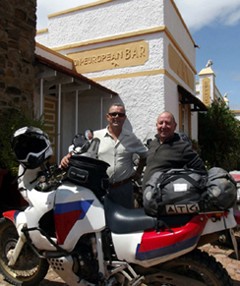
After exchanging news from the last two years or so, Jacque scurried off to the kitchen to rustle us up some good plunger coffee and cheese toasties. When he walked away I noticed his toenails were still in drag: painted a bright red for the weekly “Steytlerville Follies” where he cameos as Karoovian diva, Dame Leyla Lamborghini and is partnered by his immensely talented life-partner, pianist Mark, who goes by the stage name, Freddy Ferrari.
Sitting there on the stoep, enjoying our late breakfast, I thought back to the times I’ve stayed here and visited over the years, and how I’ve always come away feeling incredibly relaxed. Up there with the best time I’ve had there was when the “Stone”, David and I overnighted many years back and the boys put on a very special cabaret show for us. So, if anybody is under the illusion this venue is only for arty thespians, think again. It’s a biker venue of note; just make sure you book well in advance as it’s become increasingly popular.
Following this cultural pit stop, Johan and I took to the road again. The dirt track to Kleinpoort on the R75 was also mostly new to me as I’d only travelled a short section of it from the eastern side when I’d visited Haaspoort Nature Reserve many years ago. The road follows the contours of some scrub-covered hills just to the north of the track and is surrounded by a number of game farms and nature reserves. So, apart from enjoying the absorbing track, which twisted through a contrasting landscape of small poorts and arid flatlands, we were spoilt with a number of antelope sightings — the most impressive of which were a herd of rubber-necked giraffe that looked at us quizzically; as if we were aliens from planet Zog, or something. Clearly they don’t get many adventure-bikers out this way.
As we intersected with the tar at the hamlet of Kleinpoort, the missing degrees of heat we’d wondered about earlier were quickly stacked back onto the thermometer’s scale, and then some. The mercury was now pushing 35° C and it was not even midday yet. It’s at times like these that I eschew my penchant for dirt and gladly take off at speed on the tar, grateful for the ram-air cooling effect the wind provides.
Apart from the cooling benefit, the tar road also allowed us to make up some of the time we’d lost languishing on the theatrical hotel’s stoep earlier. Having bought the Twin primarily for use on longer journeys — where you need to travel at higher speeds to get to far-flung destinations — I was pleased with how it was performing on the open road. I was able to maintain an easy 130 km/h without feeling the engine was revving too high; and while this is not a whole lot more than the KLR’s comfortable cruising speed of around 120 km/h, the torque from the two cylinders allowed me to maintain this pace regardless of gradient or headwinds.
But, filling up the bike in Kirkwood a little later, I noticed once again how thirsty my new mount was by comparing consumption figures with Johan’s BMW R1200 — I was using nearly 20% more than he was. Yet, who can put a price on true love? I asked myself, the roar of the Twin’s motor through the two-into-one pipe and Leo Vince silencer soothing the practical pedant’s bleating in my head. Let’s just hope the rand/dollar exchange rate improves sometime soon; but, of course, that’s about as likely as the government being able to answer the students’ demands for “free tertiary education for all.” Ja, nee mense, the paw paw is close to hitting the fan in our beloved country – almost time to take cover.
Back on the 32 km, fruit tree-lined dirt track from Kirkwood to Coerney (a station on the other side of the R335, bordering the Addo National Park) I was faced with a T-Junction I hadn’t been expecting. Luckily, Johan had been this way before, and knew we had to make a “sho’t right” onto the R335 —coming down from the Zuurberg Mountain Inn — before we would T-bone the tarred R342, which in turn was to take us to the N10 at Paterson.
With the all-important RWC semi-final between the Bokke and All Blacks due to start at 5 pm, we were once again pleased to have a section of tar we could make up some time on. What I didn’t expect, though, were the many potholes in these tar roads, many which were the size and depth of beach balls. Hit one of these at speed and it would be game over.
At the N10, we turned left and travelled 11 km north and, just past Bellevue Kop, turned right onto another stretch of tar (17 km) to Alicedale on the banks of the Bushmans River. A railway junction on the main Johannesburg–Port Elizabeth line, the town used to be home to an important railway training facility; but it if it weren’t for the Bushmans River Sands Hotel there today — with its 18-hole golf course, there’s little doubt Alicedale would have become a ghost-town by now.
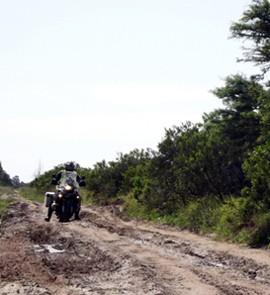
Made us feel like we’d entered the Congo after a rainstorm.
I was looking forward to getting back onto the dirt again and Johan assured me that some of
the best riding was yet to come, “particularly the last stretch between Southwell and Bathurst,” he opined. And the road forward, running on top of and between high rolling hills covered with spiny-thicket was just as beautiful as Johan had made out. But what neither of us expected was just how bad the road was going to get before we reached Southwell.
In fact, just after hitting the N2 towards Grahamstown for 2 km, and then turning right at a signboard called “Mosslands”, I was in my element. We had struck out on the holy grail of all dirt tracks for me: the secondary, secondary gravel road – more commonly known as a jeep or farm track. Even after it became more of a twee-spoor a little further on, both of us were enjoying scything through the lush farmlands and the occasional copses of blue gum and poplar tress which provided a bit of shade along the way.
But this happy state of affairs came to an abrupt end soon after crossing over the R343. The road got worse and worse until, just after a farm turning to the right, it kind of disappeared altogether. All that was left of this derelict dirt track was a series of narrow ridges and deep dongas, seemingly carved out by Central African-type rainstorms and the odd, doggedly persistent farmer passing through on a tractor.
Being on the Africa Twin for the first time, I was a little unsure of how to handle this sort of enduro-cum-trials terrain, but in the end there was only one thing for it. Having to follow 20-30 cm wide ridges winding through a minefield of 50-90 cm deep dongas meant paddling along was out of the question; the only course to follow was the old: look up, stand up and open up routine. And, besides a few ‘benoude oomblikke’, balancing on the edge of a number of precipitous drops here and there, Johan and I conquered the 5 km or so of rough stuff without incident. Once again, I was amazed at the capabilities of my new mount.
Adding to our chagrin through this former section had been the concern that we may not make the kick-off in time, so once we got onto the slightly better dirt track road in from Southwell, we hammered it a bit. As Johan had done this final section before, I asked him to lead us and his earlier promise of breath-taking roads and scenery came true in spectacular fashion as we descended through and then over the range of thicket–covered mountains that lie between the “Waters Meeting 1 and 2 Nature Reserves.”
By the time we arrived at the Pig and Whistle at 4 p.m., the pub was filling up fast and we needed to hurry to ensure we got a seat for the game. But after 450 km of mostly demanding dirt track, ridden in 35° C heat, I was determined to first throw my bags down in the room and then grab a quick shower and a change of clothes.
Later I found Johan ensconced in an old wingback chair in the inn’s lounge and he’d thoughtfully kept me a seat close-by. With five minutes to kick-off, we both had ice-cold quarts of beer in our hands and big smiles on our faces — we had pushed ourselves hard and come through without incident so we felt like we’d really earned a few cold ones. Of course, we would have loved a Springbok victory to round things off, but it wasn’t to be.
The mostly tar route plan for the next day — mainly good coastal roads with one or two short dirt track detours thrown in — meant we could leave a little later the next morning. Yet, having hit the sack fairly early after an excellent dinner and even better bottle of Beyerskloof Pinotage, I was awake just before dawn the next morning.
Well-rested, I decided to take a walk around this historic village and was wooed by its wide dirt roads, lush vegetation and the stoep-surrounded Victorian houses languishing on their large plots. For anybody with a passing interest in South Africa’s settler history, you could do worse than take in some of the historic points of interest here. Among these are Bradshaw’s Wool Mill, the place where South Africa’s wool industry is reputed to have started (only a two kilometre walk from the Pig and Whistle) and the Toposcope on a hill behind the town — it graphically indicates where the original settler’s farms were located.
When I got back to the Pig and Whistle Inn a while later I wondered if my great-grandfather, George Henry Yell, the last harbour master at Port Alfred 16 km down the road, ever slaked his thirst at this venerable old public house. First opened in 1832 by blacksmith Thomas Hartley, the pub (then called the Bathurst Inn) is said to be the longest continually operating pub in the land; but only garnered its current name about 100 years later when a group of Royal Air Force pilots stationed nearby named it after their favourite local in England.

institution since 1832.
When I was a student at UCT; majoring in beer drinking, rugby and womanising I hesitate to add; legend had it you could have a beer at opening time at the Pig in Bathurst and then be able to drive to the Pig in Rondebosch (sadly closed for many years) and still be in time for a beer before closing time. Something I unfortunately never tried before I was forced to leave the ivy-league for my national service in the navy and then a career in advertising in Jo’burg.
“What seems to be the problem with the Twin’s indicator, Nick,” asked Johan who was freshly showered and positively bristling with readiness to leave.
“I’m afraid the person who fitted these indicators and clamped the wires tightly onto the frame didn’t allow for the kind of rear shock travel we experienced yesterday — the wires have pulled clean out the bulb socket and I’m battling to crimp it all together again,” I replied, the sweat dripping off me in the humid conditions which were already starting to wring me dry; and it was only 8.30 a.m. I was starting to understand and appreciate the tag-line which underpins the town’s brand: There’s no thirst like Bathurst.
After these running repairs and me having had a shower, we were on the road by 10 a.m. The sea breeze on the coastal road was welcome after my earlier exertions and I was happy to follow Johan as he led us onto the Boknes-Cannon Rocks detour a little way on. But when we came to an imposing looking electronic gate a few kilometres ahead, complete with a sign shouting “Road closed”, Johan had to lead us to an alternative dirt track he knew.
It was a serendipitous turn of events as this alternative detour took us on an up-hill-and-down-dale rollercoaster ride which eventually spat us out in the township behind Alexandria, some 21 km later. After pushing the limits on this detour — I was starting to bond with my legendary beast, big time — I had worked up quite an appetite and suggested to Johan we have brunch at a farmstall just out of the town.
Refreshed we stretched the throttle cables tighter and rode into the gale-force headwind on the road to Port Elizabeth. When I last rode this route on my KLR, with Pieter and Johan in front of me after the Wild Coast Tour some years back, the wind had been even stronger and I enjoyed being on a heavier bike this time. But, I was to discover the one nagging disadvantage of my new set-up soon after saying goodbye to Johan outside Port Elizabeth.
Travelling on my own again, my plan was to ride the N2 to the R62 turn-off, then make my way up the Langkloof to Uniondale and overnight at Hartebeest Post farmhouse once more. I’d calculated by this stage that my 25-litre tank should give me a range of between 300 and 350 km and was planning to fill up the bike at the Engen at Humansdorp; where I also intended drawing some money and drinking a mega-coffee at the Wimpy there.
I was so focused on battling into the wind and trying to keep my go-forward speed around 140 km/h I drew a blank when I came abreast of the Cape St Francis turn-off; not realising until 12 km later that it was also the Humansdorp exit I had been looking for. Realising my mistake, I quickly made a U-Turn and promptly ran out of petrol. Annoyingly, the odometer was only on 275 km — clearly the strong headwinds and consistently higher speeds I’d been travelling at had sucked the Twin’s fuel tank dry.
I half-heartedly tried to flag down a few cars, but when none had stopped after a few minutes, I decided to wait for the first biker I saw. Ten minutes later a couple on a KTM 1190 and another fellow on a BMW GS 1150 stopped. Leon and Karen Fouché of Uitenhage and Hermanus Havenga were on their way back from the “Ostrich Run” in Oudtshoorn and were only too happy to do the 25 km round trip to get me two litres of petrol in Humansdorp. Adding to their generosity was the fact that I didn’t have a cent on me to pay them back and they wouldn’t hear of it when I suggested I draw money in Humansdorp when I got going again. The brotherhood and sisterhood of bikers is alive and well in the Eastern Cape.
I was now running late, it had also started to rain lightly and the temperature had dropped to single digits. But after my earlier good fortune nothing could dampen my spirits as I made for Uniondale in the gloaming from where I would leave for Bot River the next day.
The route and travel notes:
Day 1:.Bot River to Hartebeest Post (outside Uniondale): N2 to Stormsvlei, to Bonnievale, then Montagu and R62 from there to Dysseldorp dirt track turn-off outside De Rust (392 km – tar); Dysseldorp to the junction with the N9 outside Uniondale (75 km – dirt); to Uniondale on the N9 (10 km –tar); on the N9 to the Hartebeest Post (Zaaimansdal) dirt track (11 km – tar) and then to the Hartebeest Post farmhouse (9 km –dirt). Distance Day 1: 488 km, 15 % (73 km) on dirt
Day 2: Hartebeest Post to Bathurst: from farmhouse to the Nuwekloof (Baviaanskloof) turn-off (65 km –dirt); on the R332 to Willowmore for 16 km (dirt); then right onto the Steytlerville Road for 78 km (dirt) until tar road T-Junction; into Steytlerville (22 km -tar); on the dirt track running past the Karroo Theatrical Hotel to Kleinpoort junction with R75 (55 km – dirt); from here to Kirkwood (28 km – tar); to junction with R335 near Coerney (dirt – 28 km); onto Paterson on the R335 for 25 km (tar); then up the N10 past Bellevue Kop, turning right after 16 km (tar) to Alicedale (17 km –tar); back onto dirt to junction with N2 ( 34 km – dirt), left onto N2 turning right at Mosslands turn-off after 2 km (tar); from here on difficult dirt track for a while and then reach Southwell after 47 km (dirt); from here to Bathurst (23 km – dirt) Distance Day 2: 456 km, 76% (347 km) on dirt tracks.
Day 3: Bathhurst to Hartebeest Post (outside Uniondale) via Port Alfred to Boknes (51 km – tar); Boknes to Alexandria dirt track detour (21 km –dirt); from Alexandria via N2 to Kareedouw turn-off (212 km –tar); on R62 up the Langkloof to Uniondale turn-off (149 km – tar); to Hartebeest Post via Uniondale (30 km – 21 km tar and 9 dirt). Distance Day 3: 464 km, 93% (433 km) on tar roads.
Day 4: Hartebeest Post to Bot River: to Hoekplaaspad dirt track turn-off from R339 (28 km — 19 tar; 9 km dirt); sublime dirt track to R341 to De Rust (26 km – dirt) and then via R62 to Barrydale (248 km – tar), Tradouw’s Pass to Swellendam (38 km – tar) and then N2 to Bot River (139 km –tar)
Distance Day 4: 479 km, 93% (445 km) on tar.
Total distance travelled: Around 1887 kilometres over 4 days — about 26% on dirt roads.
Experience required: Beginner to Advanced – although latter only on short sections between Alicedale and Bathurst.
Best time of year to go: September to April
Route highlights: Dysseldorp to Uniondale; Hartebeest Post to Steytlerville; Alicedale to N2 junction; Southwell to Bathurst; Boknes to Alexandria and the Hoekplaaspad outside De Rust.
What it cost us: Accom. : R660 p.p + petrol, food, drinks and snacks: R2, 200 each. Total: R2860
Equipment currently being tested: Capra X Tyres— performed well on tar, but exceptionally on dirt. Seem to have worn well and evenly thus far, but further feedback in due course.
Accommodation notes: Hartebeest Post (Uniondale); contact Lizette on 072 699 1163 and Pig and Whistle Inn (Bathurst): 046 625 0673.
Words: 4181. Copyright: Nick Yell, P.O. Box 252, Bot River, 7185.